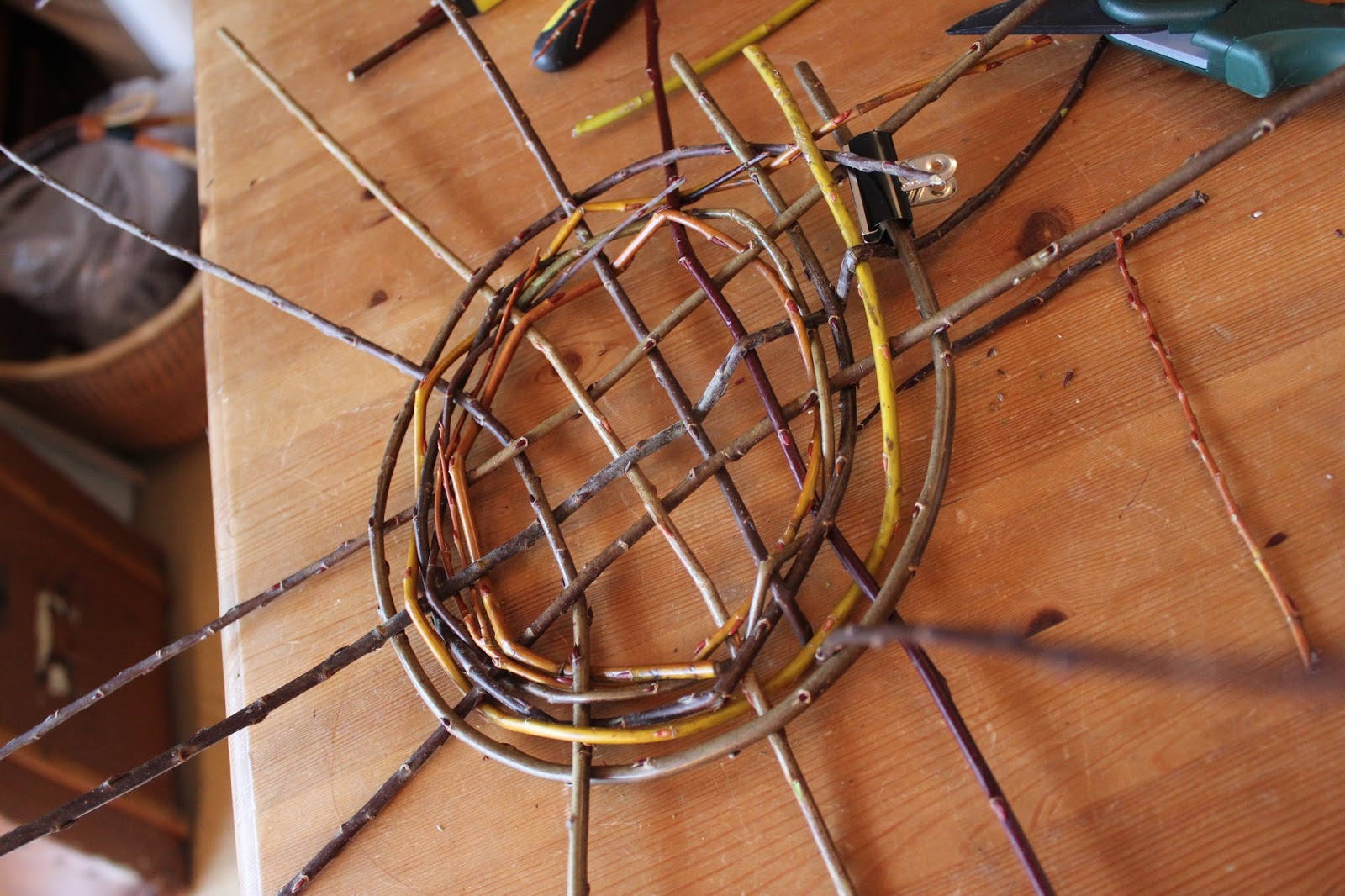
Aviva Leigh runs workshops for mainly weaving and dyeing. She has a 3D weaving workshop scheduled in a couple of weeks time and invited me along to her home studio to help her sample and experiment! She wanted to experiment with willow and wire using a circle loom and basket weaving techniques to then create a 3D woven piece. I have never used a circle loom before and I was really glad I tried it out. It was a long process but worked well, instead of a rigid heddle or a table loom, you had to manually weave the weft in and out of the warp. As we were using wire in the warp, it was much trickier than just simply cotton or wool, as it was stiff and hard to get the weft underneath. In the weft we used recycled materials such as found string and cord from the beach which had a lovely worn quality to it.
We sat looking out onto the river drinking tea and chatting whilst weaving away, which was wonderful, she has so much knowledge and it really inspires me. The day went so fast and we didn't get all of the weaving done but I have bought the circle loom home to continue to play this week.
I would love to continue to use techniques similar to this in the future, I especially love the idea of using found materials from the beach and using basket weaving techniques.
Camira fabrics supply the fabrics for transport interiors such as Stagecoach UK. I ordered some samples to see moquette up close and personal to see if there was any way to replicate this kind of material in our sampling. As a group we also wanted to have a look at the pattern on the moquette.
Although some do look very garish and vibrant, the designs have been chosen and designed for the purpose of being on transport seating and must have reasoning behind the design. Some designs have small repeats which are easily replaced if they are damaged but we have noticed the pattern is lost as the repeat is so small. Looking at the designs on previous moquette seating had given us an insight to the market already and how we want our designs to look. We have been very focused on material, practicality and durability that we haven't thought too much about the design yet.
Seating material ranges:
Aura – Traditional wool moquette in contemporary style
Classic – Soft touch genuine leather
Dimension – Polyester flat weave fabric available to order only
Elements – Contemporary high wool content moquette
Folio – Textured and metallic effect vinyl
Fusion – The latest high wool content lightweight moquette
Quantum – Lightweight polyester moquette with textured yarn options
Vigor – Backed wool rich moquette
Vision – Contemporary lightly textured flat weave offering metallic highlights and contrasting fibre types, supplied with a backing
Vita – Leather look vinyl
The video below shows exactly what Camira does and explains the material choices in the underground seating.
To continue working as a group we decided to create group drawings. We split up into our sub groups (bus types) as this would keep the colour schemes distinguished. Louise, Chloe and I used a variety of mediums on A2 paper, drawing from the Norwich Market, using the lines, marks and colours to create drawings which we could further develop into designs. We swivelled round the paper every 5 minutes to create a better composition. We overlapped drawings, continued the lines and markings from each others, connecting them so they flowed.
Other members of the group used collage to create group drawings which I feel isn't as strong as it doesn't show complete collaboration.
![]() |
| A2 group drawing |
Our meeting with Kit Miles was an eye opener. He advised us to not repeat their previous designs, creating something new and exciting. We need to investigate Stagecoach as a brand and refer back to their mission statement and aims. We learnt that commercial and residential fabrics have different regulations and rub tests.
As a group we sat down and discussed the pros and cons of moquette and leather. We aim to research further into materials for example the history into using faux leather in bus interior and the psychology behind defacing the seats.
Kit made us think about the impact and experience for consumers. We agreed to research into subliminal messages and interactive and tactile touch points in the bus interior.
![]() |
| Moquette VS e-Leather |
Stagecoach UK
Its restricted> is this positive or negative?
Sarah advised us to interpret this narrow brief creatively and appreciate how we have many restrictions meaning we wouldn't go off on a tangent. We must fulfil the brief!!!
Brand
-Identify the company
-Identify the consumer
-How do we design for a client/brand/market
-How do we respond to other brands- vital!
Research
-Materials
-Sustainability
-Previous products
-Colours
-Logos
-Target Market
-Subject Matter
-Competitors
-Primary research- bus/interviews
-Stagecoach as a company
-Aims and Mission
Stagecoach
-Wastage
-Pattern
-Colour
-Durable
-Stain resistant
Consumer
market is broad- only with age! Build a consumer profile.
Age
Income
Parent?
What do they care about
Career/job/retired
Ease/time constraint
Social Background
Cultural Background
Tube vs Bus demographics
Access (disabled/elderly/child)
Where they shop
What they do
Where they eat out
What they eat
What they wear
Where they shop for clothes
Hair style
Hobbies
Holidays
Pay for extra life luxuries (Sky tv/ wifi etc)
Pets
What do we want our designs to be?
Contemporary
Inviting
Clean
Calming
Spacious
Easy to use and practical
Simple
Interesting/ conversation starter
We have lots do be getting on with as our session with Sarah has been extremely though provoking. It has made me realise that our group brief could be really interesting, especially if we consider our consumer and explore Stagecoach Uk as a brand.
Stagecoach UK
"Design a collection of fabrics for use in updated buses used for public transport in Norwich. "
As soon as we received our brief we sat as a group and mind mapped ideas and research that we thought was vital to do to understand Stagecoach as a brand and understand the market. We realised that there were many things to consider when it comes to our brief. We knew our designs had to be practical when it comes to material as well as the actual design (repeat and colour choice)
![]() |
We also had to consider our group members' strengths and weaknesses to allocate loose roles in the group, thinking about sampling, researching and drawing.
To do next:
Research Stagecoach as brand
Research Wallace and Sewell
Research other designers
Research materials
Agree as a group on what we aim our designs to be. What are the key factors we need to create successful designs?
Where do we want our designs in the bus?
Who will use the bus?
Today I met Aviva and we traveled to her Happisburgh studio to prepare for the Makers Month Event in Feb! We sat and planned last min things such as the children's activities on the Tuesday and Thursday and chatted about my denim patch works. I up cycled 2 tables, a chair and a 2 metre stand/rail (which we are using to hand the giant patchwork at the end). I sanded and painted them using chalk paint, this gave so many ideas of my own, for the future. We plan to have all of this lovely up cycled furniture in the forum atrium for people to get in the spirit of slow, mindful, conscious making. In the blue table we plan to make markings on the edges of the table to replicate stitches and sashioko like in my denim patchwork- I think this would look really quirky add an extra handcrafted touch to it.
In the evening time I deconstructed a second hand lampshade which was part of a large floor lamp. I was left with the wire frame where I weaved, tied and loopeed the shredded fabric which I made in to yarn beforehand, in an out of the wire. I only used old pieces of fabrics, continuing the up cycling, reclaiming, reusing theme. The end result was brilliant and i think the collection of furniture will tie the whole workshop together.
The next time I will see Aviva is the day of the forum event but we plan to have phone calls between then, confirming any last minute details that might crop up.
Aviva shared so much wisdom with me and I feel like I have learnt an incredible amount with Aviva, I feel privileged to have had my placement with her.
I realised how many experimental samples I have got, especially for my Interiors project where I have been using sublimation printing. I must get a move on with some designs and choose my final ones so I can continue on with my other projects.
I tried to devore onto denim not thinking about the fibre content. It obviously ate away at the cotton and I was left with a distressed frayed effect, I thought of this as a disaster at first but realised I could use this in my boro sampling. I looked at boro examples again and discovered that the denim was shredded and distressed!!! This fits perfectly!
I then tried devore onto a cotton polyester but this also ate away most of the cotton and I was left with very little again. I plan to do this more to add to a Boro sample- then repeat this as a final.
I also devored onto my favourite sublimation repeat design (which i was going to use as a final sample) and was crossing my fingers that it would go well but I stupidly put it in the heat press for too long!! It unfortunately went black and I had to wash it various times. It still isn't how I planned but I guess mistakes happen. I do like how the fabric has changed quality, it is much thinner as the cellulose fibres have been eaten away and the synthetic fibres have been left.
Meanwhile, there was also a fabric known in France as “nim.” Both fabrics were composed partly of wool. So, how has the word “denim” thought to be from the word “serge de Nimes?" Serge de Nimes was made of silk and wool, but denim has always been made of cotton. This is a relation between fabrics that is in name only, both fabrics are a twill weave, this is the only connection and relation of both fabrics.
I8th century jean was made completely of cotton, and made to make men’s clothing, mainly for its property of durability even after many washings. Denim was stronger and more expensive than jean, and though the two fabrics were very similar, they did have one prime different. Denim was made of one coloured thread and one white thread whereas jean was woven of two threads of the same colour. I never knew this difference and I am intrigued and will keep an eye out at and look closely to the weave of the denim.
http://www.levistrauss.com/wp-content/uploads/2014/01/A-Short-History-of-Denim2.pdf
http://theswatchbook.offsetwarehouse.com/2014/09/16/what-is-raw-denim/
http://www.wgsn.com/blogs/fashion/denim/
http://minamitextiles.com/tag/boro/page/2/
Trend Reports
- As discussed, you need to create your own trend. Give your trend a name. When do you predict that your trend going to happen, and where?
- Your trend must be believable. Think about how to use images, references to other designers/trends/streetstyle/celebrity etc to convince your reader that this trend is really going to happen.
- Remember to research your trend in a wider context, referencing designers, artists, other trends etc.
- Spend time reading professional trend reports, and present your own report in a similar way, using labelled images, mood boards etc. Your report may be longer than some of the brief summaries we see online, because yours will include detailed description of your trend and how it relates to different areas of design, as well as an explanation of why the trend will resonate with the audience at this time (eg in response to a current social issue or topic).
My Ideas
eco fashion - link this with future events or news?? > recession?
deconstructs /reconstruct
mending- visible on purpose.. this could link with my fashion project?
make do and mend > too obvious? look at fashion point of view
urban denim- street style
vintage up cycling > "trendy to be thrifty"
eco friendly and sustainable
http://www.elle.com/fashion/g8913/best-eco-friendly-fashion-brands/


"Thrifty is fashionable once more and making your own curtains and soft furnishings is the craftiest way to save money."- http://www.yorkshirepost.co.uk/news/make-do-and-mend-has-become-the-new-trend-1-4325180#ixzz3voprmuaF
"The recession has given rise to the rebirth of a “make do and mend” culture, while television programmes such as Kirstie Allsopp’s Handmade Britain have spawned a surge in the number of people taking up sewing." - http://www.yorkshirepost.co.uk/news/make-do-and-mend-has-become-the-new-trend-1-4325180#ixzz3voq4DDzm
"The recession has had a big impact. People are looking at ways of saving money and learning how to do key skills themselves. You can save quite a bit of money by making your own clothes and curtains and you can make things to suit your own taste.” -http://www.yorkshirepost.co.uk/news/make-do-and-mend-has-become-the-new-trend-1-4325180#ixzz3voqkw69N
“Making your own clothes is not cheaper now there are shops like Primark, but it is about self expression and turning away from the high street to a more local economy.”- http://www.yorkshirepost.co.uk/news/make-do-and-mend-has-become-the-new-trend-1-4325180#ixzz3votDLWqh
Make do and mend was because of the recession In world war 2... will there be a recession 2016/17?? >>> http://www.cityam.com/215831/when-will-there-be-another-recession-uk-it-could-be-sooner-you-think
"A global recession is usually defined by economists as an extended period of below-capacity growth. City puts global potential growth at 3%, but expects growth to “reach or fall below 2%” before bottoming out in 2017." - http://www.theguardian.com/business/2015/sep/09/global-recession-two-years-likely-economist-buiter
"We may be on the verge of another global recession. Patterns in economic data are showing signs of weakness, and the troubles persisting in Europe or the bubble bursting in China may be the trigger that sends the economy over the edge" http://www.investopedia.com/articles/investing/071515/6-factors-point-global-recession-2016.asp
Trend Report Research
Trend forecasting help
Geraldine Wharry from WGSN tumblr
Nick mentioned to me about a relation between mine and Shirley Craven's work. I could see connections between her delicate drawings and mine and then her geometric prints and design and mine. Shirley studied at the Royal College of Art.
Shirley Craven’s extraordinary textiles condense the excitement of the Swinging Sixties.
After researching Albers and Colour theory, I noticed a direct link between the colours and shapes in my work and in bauhaus inspired textiles or drawings. It has inspired me to continue to use and use only primary bright colours (initially taken from SADACC).
The Bauhaus movement began in 1919 when there was an idea of bridging the gap between art and industry by incorporating crafts and arts. Walter Gropius stated that all crafts, including art, architecture and geometric design, should be combined and mass-produced. Gropius argued that architecture and design should reflect the new chapter in history, post World War I.
Visiting the Castle Museum today for the first time this academic year was uplifting. Seeing our work being exhibited was lovely and looking at the other years' sketchbooks was actually so helpful. I wish we has a chance to see first years' sketchbooks more often as it was refreshing to see.
Our repeat lengths were hung nicely around the museum and it was nice to see members of the public admiring them.
I also used my time to look at the natural history and wildlife area to draw from the shells there and take some photographs to refresh my drawings and give me ideas.
![]() |
| Repeat length and ribbon (from year1) |
![]() |
| Fashion for Passion event |
![]() |
| Shell and project 2 visual research |
Reassurance is what I needed to help me keep pushing my ideas forward. I know I need to get my final designs done ASAP as the fashion project needs to be started soon. I told Jill I was worried about my time management and how to put my designs in to repeat as I wanted to stay away from digital printing.
For placement overview:
-Small info about Aviva and the rest critical analysis
For the interior project:
-wallpaper- look at claire coles and look at Charlotte Abraham
-think about context?- cafe/corporate space/home/audience- adolescent/children etc
-To help me with repeat... Photocopy motifs onto acetate then flip/adjust/layer up/half drop etc
-create a complex repeat by adding depth and level- add background using subtle marks from drawings etc
-make the samples a collection so they flow together
For the Fashion project:
-Begin drawings for this project- continue with shells but explore in depth
-Indigo dyeing- could experiment with discharge and resists
-Try to give myself a title for my fashion collection- like the lecturer today who worked at USP- Jane Kellock
-Look into mending/patching
-Go to study centre- mending/darning etc
-Boro Boro book by Nuno Collection
-Try sashiko stitching with fine threads or metallic threads and explore different stitches
I tried this, after two attempts, the devore visibly worked. It wasn't very obvious which disheartened me because of the length of time it took me to do. Doing this has reminded me how devore works and now I want to use it again in my work as it is a simple and effective process to do.
I hand painted it on but I could possibly screen print it or block print with it to combine processes and methods??
![]() |
| Left top is a sample with no devore Right top and bottom has devore on some parts (brighter and more vivid) |
I initially wanted to have my collection of designs for a living area featuring cushions, a quilt and an upholstered chair but my practical work right now isn't relating well. I feel like I should carry on with the path that my work is going down naturally as I don't want to force my work to go a certain way. I am doing CAD embroidery on Monday the 30th and I will reflect once I have gained some more digitally stitched samples as I have never done this before- I might love it or hate it!
![]() |
| Habitat Ideas for cushions? I love the design in the lower centre!- stitched grids- geometric but includes interesting marks which could relate to shells etc? |
![]() |
| Anthropology throws- very textured? Could I create something like this without having to weave???? |
An African American majority community and census-designated place in a large bend of the Alabama River in Wilcox County, Alabama.
After creating some lovely pieces when sublimatiion printing I realised how geometric my prints were becoming and I began to worry that I was going off on a tangent. My initial drawings were very loose and based on shells and beach debris. My prints have become very linear, I am hoping that combining my processes such as stitching and dyeing will help change this.
I could display geometric shapes in a spiral?
I could print the disperse dyes on twisted, spiralled papers? experiment!?
I could expose a screen with detailed marks from spirals/shells and add to the negative space in between geometric shapes?
There are three basic categories of colour theory that are valid and useful: The colour wheel, colour harmony, and the context of how colours are used. Colour theories create a logical structure for colour. For example, you can organise a collection of colours then place them in a circle that shows the colours in relation to each other.
Albers was one of the first modern artists to explore the psychological effects of colour and to question the nature of perception. I find his work influential as he looks at colour in depth, his paintings/studies are beautiful just as they are and I appreciate the meanings and theories behind them.
I'm having trouble with incorporating digital processes into my work. Sublimation printing has brought on much more ideas and has excited me to move my work forward.
I could laser cut shapes/design out of brown paper with disperse dye on- then print?- has to be repeated though? how could I make this work?!?!
Print this on polyester fabric? Could use cotton polyester or linen polyester?
Layer up texture by adding resists and working with negative/ positive space.
I am interested in negative and positive space. Sometimes the marks made from drawings, collage or stitch are not as interesting as the marks that surround it (the negative space).
After researching Albers I am excited by the experimentation of combining colour and shape to see how things change. I want to include layering and experiment with opacity and overlaying. I think this could be done using photoshop.
Follow Amelia's board POSITIVE/NEGATIVE on Pinterest.
Visiting SADACC again has really helped me push my ideas further. It has reminded me of the processes and colours used in Indian Textiles. After doing many drawing workshops and improving my digital skills I feel like coming to SADACC again really enabled me to boost my ideas and help me combine the drawing skills and SADACC research.
Trying to balance the mountains of work piling up with everything else, like socialising and housework is beginning to become pretty difficult. I am trying to improve my work and make the most of my time here whilst trying to keep on top of the work that is being thrown at me left right and centre. I am determined to do better this year and get my work out into the world so I can start building connections, preparing me for life after my degree. Going to the Castle Museum workshop the other day has made me realise this.
I am attempting to improve my drawing by using different techniques and strategies. I was browsing the internet to gain inspiration (as always) and came across this article which was pretty helpful. Looking at sketchbook examples really helps me and makes me realise my work needs to have more direct connections with the pattern and shapes being made by the piece I am drawing from. I am going to draw today and keep referring back to the different drawing strategies and this other article that I also found very helpful. The second article is about creating excellent observational drawings, a point that made me think was, "keep outlines light". I realised I draw with outlines too much and not with shapes, shading and colour. I am going to add this to my never ending list of things to do and hopefully improve my drawing.
I found the Simple Geo Print workshop with Robert incredibly helpful last week therefore I decided to develop my skills further using the same steps but putting my own twist on them. I had to use trial and error to teach myself more skills in Illustartor but I found myself beginning to create really interesting patterns.
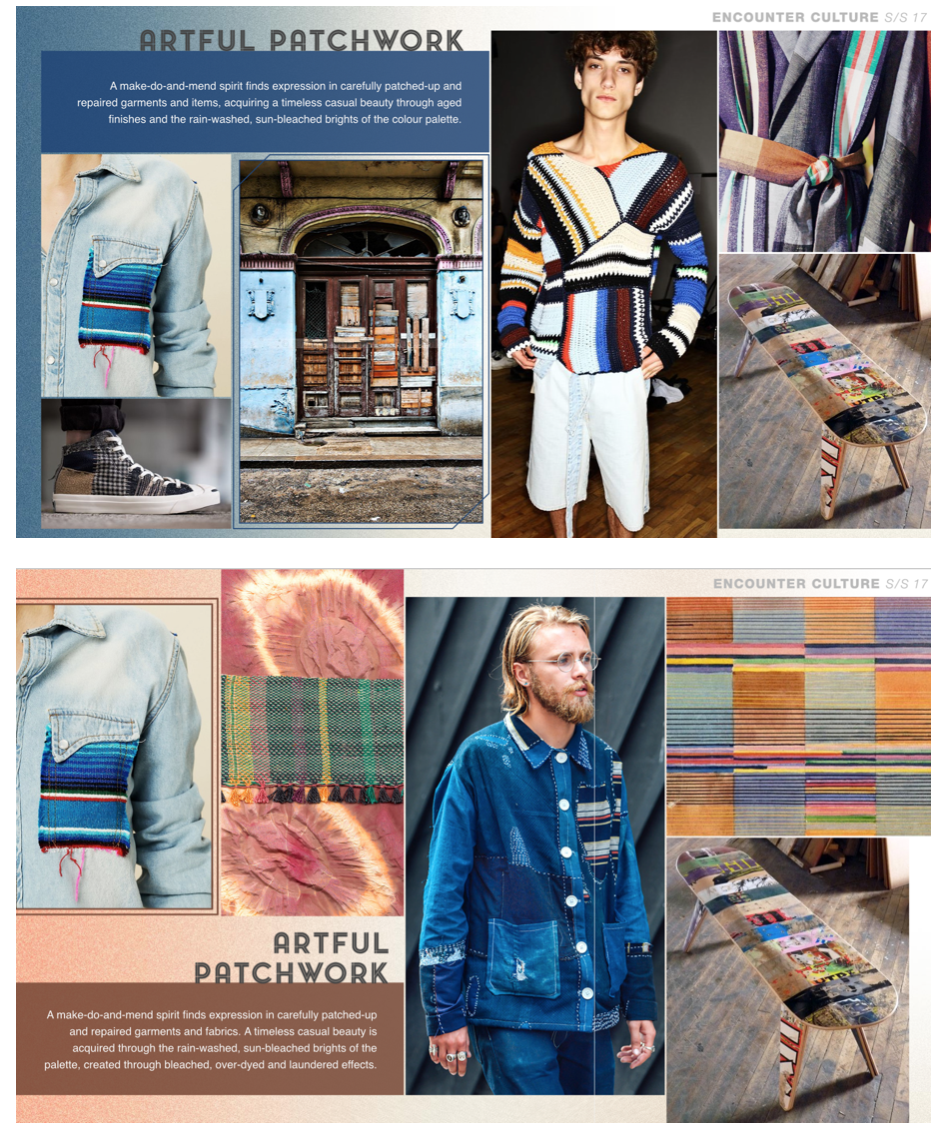
For our reports project we began researching trends for a starting point. I began looking on WGSN and saved the forecasts that caught my eye or influenced me. I really liked the 'vintage' second hand patchwork trend. It intrigued me and I had an urge to reach into the computer screen to feel the textures. I researched further into "make do and mend" looking at how it is used now and how it used be used WW2. This then encouraged me to research into secondhand/charity/vintage as these are becoming increasingly popular; even so that high street brands are copying the "vintage trend".
Make Do and Mend John Lewis pamphlet WGSN
Artful Patchwork 1 WGSN
Artful Patchwork 2 WGSN
Patched Pattern WGSN
Charity Shops During Recession
The Modern Make Do and Mend BBC News
Charity Shop Tips
Make Do and Mend IWM
Clothes Rationing IWM
Today we were informed on the importance of research which made me think I must do this more to help me with Project 2. Visits to archives, museums and exhibitions are so important as we learnt in first year so I am planning a visit to London in the next 2 weeks to visit the V&A Fabric of India Exhibition.
We were also informed about the resources online so I have spent some time exploring WGSN, Athens and the NUA library, searching through trend reports, ebooks and e-journals.
I found a very suited e-resource by Rosalyn Crosthwaite (below) which I have found incredibly useful towards my work linked with SADACC and indian textiles. She explores the use of traditional indian textile techniques as well as the changes made and influences from digital processes.
![]() |
| Crosthwaite, R. (2014) Preserving traditional Indian textile techniques from the effects of large-scale 21st century manufacturing [Online resource]. |
I signed up to an external workshop at the Norwich Castle Museum, Build your own: Tools for sharing. This was based on the special exhibition they have currently from the 3rd of October to 3rd of January. This workshop was for creative people to extend their employability skills and other creative skills and tools.
We had lectures/workshops from 3 makers; Pete Mosley, Rita Parniczky, Seb Butcher.
Personally I found Pete Mosley's the most helpful as he spoke a lot about building your own creative business in the future. He gave so many tips and smalls steps I can start making towards life after my degree. I am determined to make the most of the resources I have now at university and explore other resources like social media and e-books. I now understand how to advertise my self and connect with people. I intend to buy Pete's book, The Art of Shouting Quietly, where he explains how creative people are shy and introvert but must get their self known to be successful. To find out what your market prefers etc Pete suggested to use blogger and track popularity and see what the audience prefers. I feel like Pete touched on things that were close to home with me and I found myself agreeing to things he said and inspired by tips he mentioned.
I spoke to Pete one to one where we discussed my hometown, Northamptonshire. He visits there for workshops and I was unaware that there were any resources to explore.
Places to consider for inspiration and workshops:
-Corby Cube
-Art trails Northants
-Portfolio innovation centre at Northampton university
-Fermyn Woods
I also spoke to Rita Parniczky who is a textile artist who creates woven hangings with translucent yarn. She gave me lots of tips to stay motivated and go to London exhibitions and shops to gain inspiration. She advised me to experiment now I can as I won't always have the chance after my degree. She told us to look at other artists and their CVs to see what they did after their degree to become influenced by them. I realised that I should not miss out on opportunities and I should gain knowledge when I can to become certain on what I like and don't like! I must gain experience when I can and do not limit myself to textile design, look into architecture, fine art, psychology etc. Take risks and interview my self to find out things you didn't know before.
Because London is quite expensive to travel to I want to make the most of the resources here in Norwich and in my home town, Northamptonshire to gain the best experiences possible.
Today my group printed our repeat pattern. We set up the stoppers, t-bars and repeat distance which was faster and easier than I anticipated. I feel like I have learnt a lot about time management and working under pressure today as well as learning about the basics of repeat screen printing.
![]() |
| Group 3 metre repeat print. |

I was still unsure on my colours because I had tested them out last night and was unhappy with the way they over layed each other. I had an idea of changing the layers about, I started thinking about the colours too much and was adamant the bee on our design should be yellow. I decided to change around the colours of the layers and I found that it worked quite well. Instead of sticking to the same kind of colours (for example keeping a yellow tone on the original yellow screen with the bees and flowers) I completely changed my way of thinking to make a more investing abstract print. I really love the way this has turned out and I would love to experiment more. Unfortunately there was limited time and we could only have our large group screens for the one day but the kodatraces will be kept so I can use them to create another screen to try out and experiment with unique colour combinations. I recognised that the colours of mine and my peers prints really changed the way the print looked. Prints with bolder colours really stood out to me and were much more striking.
Whilst mixing up my dyes for my individual colour way our 3 metre group print came out of the steamer and was ready to wash. Unfortunately the yellow on our print had speckled because the dye had not dissolved properly, we did try to overcome this by blending up the dye to break down the particles, we tested the dye. unfortunately is was only when the fabric was steamed, the speckles formed. This is an issue that probably could have been resolved by boiling the dye up too. Luckily, I found this out just before i printed my own colour way (which was using a similar yellow) I boiled up the dye on the hop and then blitzed it up with he had blended just to make sure!
![]() |
| My own colour way |
![]() |
| Trying to prevent speckling in the yellow dye by dissolving the powder up by boiling and blending. |
If I could do this again I would have filled the print up more so there were less spaces, using block colours as backgrounds behind drawings and using more abstract mark making drawing. Being part of a group meant that everyone had to input their ideas which meant not everyone's ideas were listed to entirely. Group work has taught me many things and I feel more confident and happy to be part of a team again.